Who can apply for an SHC grant?
The SHC offers grants to part-fund community AEDs, with the aim of getting as many publicly accessible AEDs in Sussex as possible.
The grants are available to any local community that meets the eligibility criteria (see below).
You can apply as an individual, or as part of a community group or club.
What do I need to know before I apply for an SHC grant – what is the eligibility criteria?
SHC funded AEDs must be:
- Freely accessible to the public 24/7
- Placed externally in the supplied unlocked cabinet
- Registered with The Circuit
- Have a nominated ‘guardian’ (who will be responsible for the upkeep and maintenance of the AED)
Please also consider the following before applying for an AED:
- You will need to make a contribution of £900 towards the overall cost of the AED and cabinet. (The cost of an AED is between £1,800 and £2,000. The £900 pays for a portion of the package you receive whilst allowing us to continue to fund AEDs for other communities.)
- The defibrillator must be located within Sussex (East Sussex, West Sussex, or Brighton & Hove).
- You must investigate if there is already an AED located nearby.
- Do you have or need permission for the AED to be installed at the proposed location? (you must have the landowner’s permission)
- The cabinet must be connected to a mains power supply. This must be done by a qualified electrician – you will need to organise the installation.
- Are there other organisations nearby that could also benefit?
- How will you raise awareness of the device once installed?
Please read on for FAQs on the AED package we supply – and the support we offer.
If your question is not answered, please get in touch with us via the contact form below.
How do I apply for an SHC grant?
You can apply via our online application form:
https://www.sussexheartcharity.org/aed-funding/
Please make sure you read the declaration at the bottom of the form before you submit your application.
How do I know if my application has been successful?
The SHC will review all applications and aims to respond via email to all applicants within 30 days.
What is the make/model of the AED I will receive?
HeartSine Samaritan
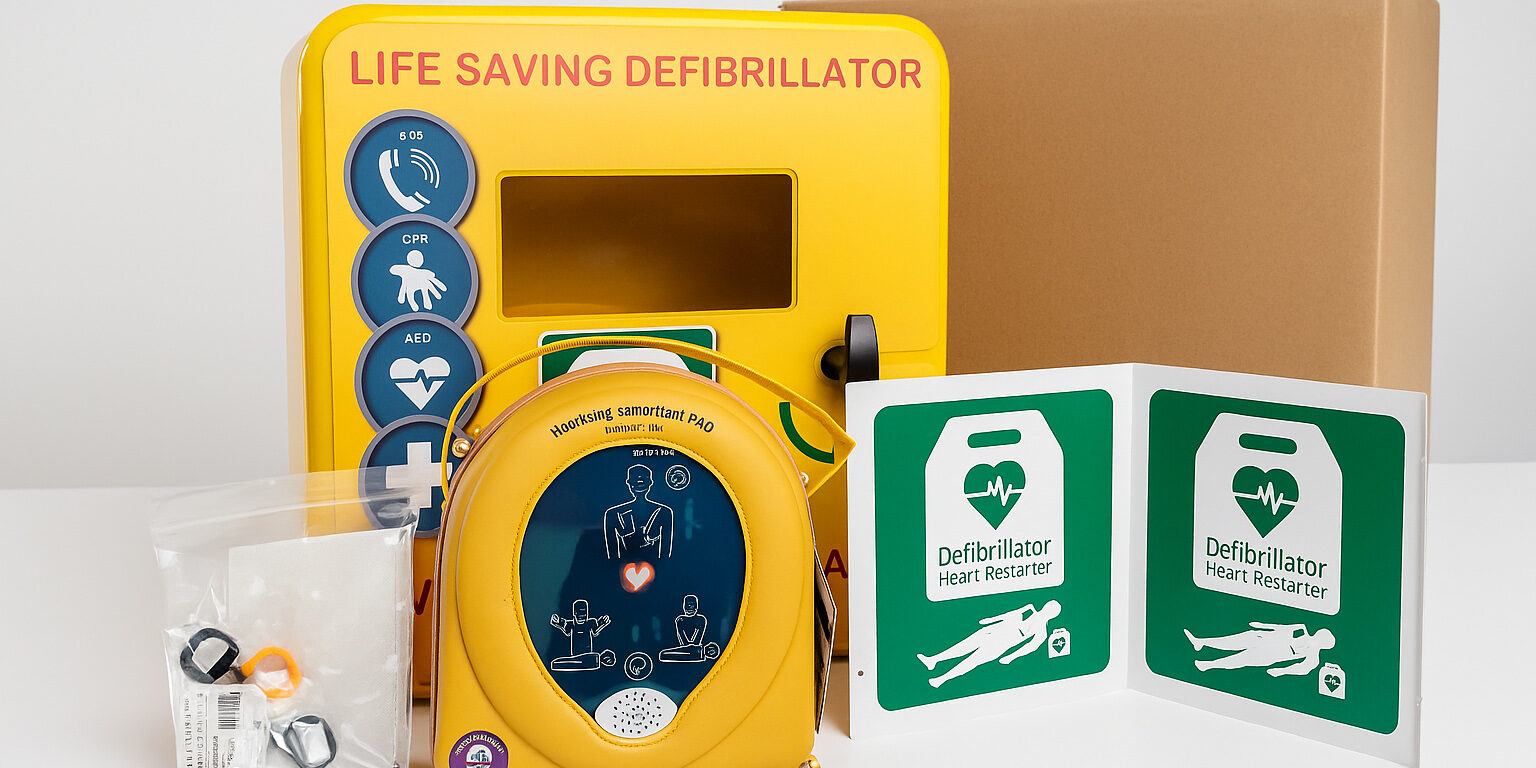
SAM 360P Fully Automatic Automated External Defibrillator
The individual serial number for the AED can be found on the case of the device.
You will have been supplied with a product user manual with your AED package.
What else do I receive in my AED package?
As well as your AED device, we will supply you with the following accessories:
- Carry case
- Consumables – 1 x Adult ‘Pad-Pak’ containing the electrode pads and battery
- DuraFib or DefibCaddy External Unlocking Polycarbonate Cabinet with alarm, lights and heater
- Ready Kit containing a CPR Face Shield, vinyl gloves, disposable razor, Tuff Cut scissors (for clothing), wound cleansing wipes & gauze swabs
- Triangular AED wall sign
Please note:
The HeartSine consumables come in a ‘Pad-Pak’ – this is a single-use removable cartridge that combines the battery and electrode pads in a single unit.
As part of your AED package, you will also receive:
- AED Familiarisation / Basic Life Support session for ten people
Details on how to claim this offer are in the supplied ‘AED Information Booklet’ (a PDF copy will be emailed to all successful applicants, and a printed copy will be included with your delivery).
Who is responsible for the AED?
Each defib must have a named ‘guardian’, who will be responsible for its upkeep and maintenance. You will need to choose someone for this role who has access to the defib and will be able to manage and monitor it on a day-to-day basis. They will also need to register the AED on The Circuit (the national defib database) and complete The Circuits regular service checks.
Once your AED has been awarded, The Sussex Heart Charity assumes no responsibility for the defib.
How will my AED be delivered?
Option 1: Delivery via courier – we will book the courier and will confirm the delivery info with you.
Delivery will be dependent on courier availability.
Option 2: Collection – you can collect the package from our storage unit in Brighton.
We will provide collection details as required.
The AED device and accessories will all be supplied in one box. The approximate weight and dimensions of the box are:
Weight: 10kg
H50cm
W56cm
L56cm
Why do you supply an unlocked cabinet – will this not increase the risk of theft or damage?
For an out of hospital cardiac arrest, quick defibrillation is necessary for the best chance of survival. AEDs placed in locked cabinets require a member of the public to ring the local ambulance service to obtain the access code which could waste valuable time.
The Sussex Heart Charity has placed over 300 devices throughout Sussex with theft and vandalism affecting less than 1% of them over the past five years.
You should not worry about your AED being in an unlocked cabinets for several reasons:
- Accessibility During Emergencies: In an emergency, every second counts. Unlocked cabinets ensure that AEDs are quickly and easily accessible when needed, potentially saving lives by reducing the time it takes to start life-saving procedures. In most cases, a second person would have to call emergency services to get the code to unlock a locked cabinet, which wastes valuable time.
- Low Risk of Theft or Vandalism: Despite concerns, AEDs are rarely stolen or vandalised. The value of an AED is primarily in its medical use, which limits its appeal to thieves. Additionally, the public nature of most AED locations deters potential vandals or thieves.
- Public Awareness and Trust: Making AEDs readily accessible promotes public awareness and trust in emergency preparedness. It signals that community safety is a priority and encourages more people to learn how to use AEDs, increasing the likelihood of effective intervention during cardiac emergencies.
- Encouraging Public Use: Easy access encourages bystanders to act during a cardiac emergency. If people feel that an AED is locked away or difficult to access, they might hesitate, reducing the chances of a successful resuscitation.
- Reduced Vandalism Risk: Interestingly, locked cabinets can attract vandals who see the locked device as a challenge or target. Unlocked cabinets reduce this temptation, as the AED is seen as a standard, non-valuable public resource.
- By keeping AEDs in unlocked cabinets, communities prioritise immediate access and the potential to save lives over the relatively low risk of misuse.
In addition, extensive research by the Resuscitation Council UK has shown that locked cabinets do little to deter vandalism and theft.
Does the cabinet need to be connected to a power supply?
Yes. The power supply is needed for the lights, alarm and heater to keep conditions inside the cabinet optimal for AED storage.
Who is responsible for installing the cabinet?
You are responsible for finding a competent electrician to install the cabinet and connect it to mains power.
Appropriate electrical connections need to be made by a competent electrician – we are unable to recommend or source electricians for you.
On request, we can provide installation instructions and a wiring diagram.
If you do not have a contracted electrician who can install for free, you may find that as this is a charity initiative, someone will offer their services for free or a reduced fee.
Please note: if you are not the landowners, you must get the landowners permission before installation.
Does the AED require mains power or charging?
No, the AED device is powered by its onboard battery (which is part of the Pad-Pak). The battery is non-rechargeable and has up to a four-year lifespan.
Is the cabinet waterproof?
Yes, the cabinet we supply is IP66 certified for outdoor use in the most extreme environments.
How much power does the cabinet use?
The cabinet uses very little electricity.
LED light – 0.5 Watts Per Hour
Digital Temperature Display – 3 Watts Per Hour
Heater – 100 Watts Per Hour when activated
Approximately £5.00 to £7.00 year or 0.018p per day.
What do you mean by 'alarmed cabinet'?
The cabinet we supply features a 120-decibel alarm which sounds when the cabinet door is opened. This acts as a deterrent for improper use and serves as an audible indication that someone may need help.
A remote is supplied with the cabinet for the Guardian to silence the alarm for carrying out checks on the AED.
Where should we put the Triangular AED wall sign?
The sign should be mounted somewhere where is it visible from a distance. It is designed to notify the public that a defib is nearby – so somewhere like the corner of a building where it can be seen from various angles is ideal.
The sign should NOT be placed right next to the defib cabinet – if you can see the sign, you can see the defib.
What do we need to do once the AED cabinet has been installed?
The Guardian will now take on the responsibility of looking after the defib – and will need to do the following as soon as the defib cabinet has been installed.
Get the defib ready to use:
- Insert the Pad-Pak into the rear of the defib. It will only fit one way. Wait for the green ‘status indicator’ light. (if you have any issues – see below for info on how to check your HeartSine device).
- Make sure your defib is stored within the supplied soft carry case. It is important that the AED Ready Kit is kept with the AED as it contains items you will need in an emergency. There is a compartment at the rear of the carry case for the Ready Kit (it can also be used to store a spare Pad-Pak if required).
- Place the defib in the cabinet. Make sure it hangs from the hook and the ‘status indicator’ light is visible through the window.
The guardian will also need to:
- Complete The Circuit registration. Once you have provided us with your details, we will pre-register the device on The Circuit on our organisation account. We will provide you with info about how to complete the registration. It is important that this is done asap, so that the AED is visible to the ambulance service.
- Register the defib with HeartSine to activate the limited warranty. You can do this by completing the registration card (supplied with the AED) or by visiting the HeartSine website:
https://uk.heartsine.com/warranty-registration/
- Write your contact details / address on the AED using a permanent marker. If the device is deployed by the ambulance service or in the unlikely event that it’s stolen, marking the defib makes it easier to return.
- Familiarise yourself with the operation of the defib and make the relevant people aware of its location.
- Create a schedule for weekly checks. Please see the ‘AED Troubleshooting’ section for info on what checks should be done.