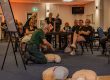

Is training required to use an AED?
AEDs require no formal training. They are very safe and are easy to use – they can be operated by the public as well as medical professionals.
However, we understand that having the confidence and knowledge to use AEDs in an emergency situation is very important. We therefore offer the following initiatives that aim to empower local communities to make sure everyone is ‘rescue ready’:
- If you received an SHC AED grant, your package includes a free AED Familiarisation / Basic Life Support session for ten people. Details on how to claim this offer are in the supplied ‘AED Information Booklet’ (a PDF copy will be emailed to all successful applicants, and a printed copy will be included with your delivery).
- Our ‘Rescue Ready’ project supplies free AED and CPR awareness sessions to community groups across the whole of Sussex. Please see our website for more information:
How often should I check an AED – and what should I check?
We recommend that AEDs are checked at least once per week – this is the responsibility of the nominated guardian.
Regular checks are very important – it is essential that your device is fully operational and ready to use in an emergency.
Please refer to your user manual for information relating to your AED model.
All defibs should have a status display on the front of the device – if the device is in working order this should be lit up with a green light.
Weekly checks should include:
- Make sure you’re aware when your consumables expire
- Check for any obvious signs of damage – including the cabinet
- Make sure the response kit is in order.
- Is the status indicator showing as ‘rescue ready’
- Has the defib been used?
All devices self-test on a regular basis and will alert you if there are any issues by beeping, flashing etc – if a fault has been detected this must be investigated asap. (see below).
The AED is beeping, flashing or displaying an ‘error’ message - what does it mean?
If a defib beeps, flashes and / or displays an ‘error’ message on the screen this indicates that it has found an issue during self-testing that requires attention.
Any faults or concerns should be investigated and sorted asap – and all issues should be reported to the guardian.
Please check that your consumables (pads and batteries) have not expired and make sure the pads are correctly connected.
Always refer to the user manual for your model. Contact the manufacturer or your supplier if you have any issues.
The AED is not turning on - what should I do?
Check that your consumables are inserted correctly.
If that does not resolve the issue, we would suggest contacting the manufacturer or your supplier. They should be able to help with troubleshooting and advice – and if your device is still under warranty may be able to offer a service or replacement if required.
How do I check the expiry date of the consumables?
The expiry dates will be written on the back of the pads / battery
It is recommended to order replacement consumables before they expire.
What is the shelf-life of the pads and batteries?
If unused, the lifespan of the pads and battery is approx. 4 years (depending on the model of your defib).
Depending on your model of defib, the pads and battery could be separate or be one unit. If they are in one combined unit, the whole pack will need replacing at the same time.
Please note: as the battery and pads are consumables, this means that if you have a spare pack, it will expire regardless of whether it’s inserted in the AED.
Do AEDs need servicing?
A full service by a qualified engineer could find issues and faults not picked up by the devices self-testing.
A full service should offer:
- Run diagnostics
- Comprehensive evaluation of the consumables
- Examination and cleaning of unit and connections
It is advisable to get your AED serviced if you’re experiencing issues with your device.
Please check the manufacturers guidelines for your model – and check with the manufacturer or your supplier to see what professional service tests they can offer.
What happens if the AED is used?
If your defibrillator is registered on The Circuit, you will receive an automated email if the emergency services have sent someone to fetch it. The AED will then show as ‘Not Available’ on the defib finder website.
Typically, if used, the AED will be taken away with the casualty by the ambulance service. It will be returned to you. We recommend that you write ownership details on the back of the device in permanent marker so it can be returned easily.
After your AED has been used, you will need to:
- Check the device for any signs of damage
- Run checks to make sure everything is in working order
- Immediately replace any items that have been used – i.e. the pads and any items from the ‘rescue kit’ pack (razor, gloves etc).
- When the device is ready to use again – update The Circuit to show the device is ‘available’ again.
Can pads be re-used?
No – the pads are single use and if used, they will need replacing immediately.
Do not use again.
Please note – for consumables where the battery and pads are in one unit, the whole unit will need replacing if the pads are used.
How do I dispose of used or expired consumables?
Batteries contain lithium and therefore need to be disposed of correctly – they should be placed in a battery recycle bin, or you can contact your supplier or local council to arrange a safe disposal.
Batteries should NOT be placed in household bins.
For recycling options in your area, please click the link below:
https://www.recyclenow.com/recycling-locator
Pads do not contain hazardous material – but you will need to cut the electrode wire before disposal.
Unused pads can be disposed of in general wate.
Used pads may have been contaminated and should be disposed of correctly.
Where can I buy an AED device and / or new consumables from?
If you need to purchase an AED or consumables, we recommend the following suppliers:
What brands or type of AED would you recommend?
We do not recommend any brand or model in particular.
As part of our ‘AEDs in the Community’ project, we supply HeartSine Samaritan
SAM 360P Fully Automatic Automated External Defibrillators – but if you are buying your own defib, the type you choose will depend on the where the device will be located, who will be using it and what features you require.
Things to remember:
- Defibs are either semi-automatic or fully automatic. The difference is how much action is needed from the person using it – both are easy to use, but you should choose which option works for your situation.
- IP rating – Ingress protection ratings are about how well-protected your defib is against things such as water and dust. Most defibs have a rating of 55 (resistant to normal amounts of dust and water). If the location of your defib is more extreme (e.g., is it likely to get wet or will it be used in an industrial setting) you should consider a model with a higher rating.
- Connectivity features – most defibs will include and SD port, infrared and Bluetooth. If you will need to monitor your defib remotely or require a motion sensor, you will need to look at more expensive models
I have another question about my AED, who should I contact?
We would advise getting in contact with your supplier or manufacturer.
Please do get in contact with us using the contact form below if you require any additional information or assistance.